




Since the 1970s women have launched into the professional world in unprecedented ways. In 2009 women accounted for 46.8 percent of the labor force. In the coming years that number is only expected to rise as women now outnumber men on many college campuses. In addition, the recession has led to greater layoffs for men than women, leaving women in the majority in many professional fields. The Christian working woman faces unique challenges in the various seasons of her life. From the recent college graduate trying to navigate her career path to the mom juggling career, husband, and children, finding time to balance it all can be difficult.
Diane Paddison, author of Work Love Pray: Practical Wisdom for Young, Professional, Christian Women, understands the myriad issues professional women face. She speaks as a seasoned professional to younger women in the early stages of their career. As a Christian woman who has had to learn how to balance work, family, and church, she provides practical advice for how to juggle all of the balls a Christian woman might carry.
Good Word for Professional Women
The issue of whether a mother should work outside of the home is a contentious one. Both sides of the argument hold tightly to their position. One of the most helpful aspects of this book is that Paddison does not speak negatively about women who choose to stay home. This book is not a defense of women in the workforce. Rather it is a book for women who are in the professional world either by necessity or choice. She clearly understands her audience and seems to have a lot of respect for women who choose a life different from her own (8).
Often women in a professional environment feel pressure to choose career over family. Paddison is emphatic that this does not have to be the case. Through her experience as a corporate executive, she provides a framework for a working mother to think through how to balance work and family without losing treasured family time (83–88, 95–100). In a corporate culture that often prizes personal gain at the expense of family, this emphasis is helpful for the professional woman.
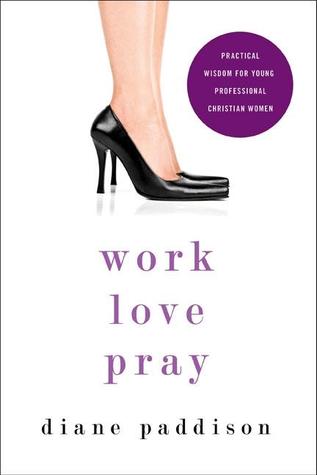
Work, Love, Pray: Practical Wisdom for Young, Professional, Christian Women
Diane Paddison
Work, Love, Pray: Practical Wisdom for Young, Professional, Christian Women
Diane Paddison
The number of Christian women in today’s professional workforce is increasing, and they are hungry for practical mentoring. They yearn to learn from someone who has climbed the ladder of success without sacrificing family or faith―something author Diane Paddison has done with excellence and grace. The stories Paddison shares about her corporate, personal, and spiritual life, as well as the lives of other women like her, are both inspiring and instructive, providing on-target advice and concrete examples of how to succeed without feeling overwhelmed or compromised. This is a working book for working women.
With the busyness that comes with balancing a growing career and growing family, other important things often can be neglected—including local church involvement. Paddison acknowledges that for a professional woman finding her place in the church can be hard. She raises valid concerns about how churches should minister to women who can’t come to a mid-day Bible study or participate in Mother’s Day Out (132–134). The reality is that in many of our churches women are working outside of the home, and we have to learn to adapt to these realities. But despite feeling like a misfit in church at times, Paddison is adamant that the local church is still God’s good means for our growth as Christians (135). She cautions against thinking only in terms of our own “needs” when we come to church, instead encouraging women to see ways they can be involved that might be outside of what they typically choose (138–139). She provides tips and examples of ways to use your gifts to serve your local church (137–138). This is a helpful word to the working woman struggling to find her place in her church. It’s not a glib disregard for how she might feel, but it does point her towards God’s good plan for her growth as a believer—and one of those means is through the local church.
Cause for Concern
While Paddison does present a clear plea for the local church, and even the need for women to remain committed to their faith while working, she does not spend a lot of time talking about the object of that faith—Jesus. In fact, besides a few references to him throughout the book, he is not really the focal point in a number of her discussions. It is obvious that her desire in this book is to help women learn how to balance faith, family, and work (faith being the primary category). It seems that this point could have been strengthened by a greater emphasis on the Savior and Scripture. Women who have to balance home, work, and church face a tremendous challenge. And while she discusses the importance of Scripture intake and study, the book would have been served by more talk about the gospel of Jesus Christ backed by Scripture (144–151).
Because Christ is not the center of the book, some of her conclusions can occasionlly sound triumphalistic. Counseling how to recover from making a mistake she says, “You’re a good mom who is a normal human being. When you make a mistake—whether it’s at home or at work—get over it and move on with your head held high” (195). While it is important to not dwell on past sins and failures, the most important thing to remember in the wake of such circumstances is that there is a Perfect One who is sufficient to cover every sin we have ever committed and who obeyed perfectly on our behalf. Holding our heads high and believing that we are a good mom, wife, or employee will only increase the burden of guilt and shame we feel if we do not couple that with the One who makes us good in our Father’s sight.
Paddison seems to have a tremendous heart for women. She has walked through the seasons of singleness, marriage, parenting, and now empty nest, and has worked to make her life one that is modeling the Lord. In a culture that celebrates feminism and brashness in the corporate world, Paddison tries to present another way for professional Christian women. This is a good thing. But her “pick yourself up by your boot straps” attitude can paint a world where balancing all of these spheres well is possible. And she truly believes it is (192). Perhaps for her it is, and that is a blessing. But for a number of professional women, many would say that something always has to give in order for one area to be done with excellence. Only time will tell.
The bottom line is that women are entering the work force in large numbers. The church must be ready to minister to them in ways that might look different than the programs implemented in previous generations. Though Paddison does not provide the most comprehensive manual for helping women treasure Christ in this season, she does raise valid concerns and questions that can get women in the church thinking.