



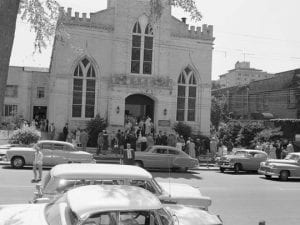

This weekend, I had the disquieting experience of attending a local church in my home town. It was “disquieting” for a number of reasons.
1. There was the blend of hope and history so characteristic of African-American churches. What’s wrong with that? Well… at first glance, nothing. But… it was a humanistic hope and a selective history.
2. The sermon was full of truth and the preacher said some things that took real boldness and love. But… almost none of it had anything to do with his chosen text nor were Gospel links and implications drawn out. Good truth… no grounding.
3. The songs… well, it was a Black church! The songs were great. There was good theology in most of them, sung in the experiential key of black folks. I was moved. Then, the shoutin’ began. One lady immediately in front of me; I placed a stiff arm in the small of her back and tucked my feet and toes under the pew. A few moments later a lady sitting next to my wife and youngest daughter lept from her seat. An older woman left the choir stand and began shouting. The pastor, a slight fellow with a big mouth (his self-description), tried to hold her up but was buried beneath her when she came down on him in piles! The most disquieting moment came in the midst of all this when my 7 year old daughter looked up at my wife and said, “It’s a zoo in here!” We don’t know where she got the phrase from; we don’t like the overtones that she is oblivious to but we know all too well; we don’t want her confused theologically or practically about what she saw and its appropriateness; we are concerned about her conception of black religious expression and identity; and, yet, the ethos feels so important, so essential to our experience.
It was a disquieting Sunday.
Perhaps it became a bit clearer for me that reforming the African American church isn’t merely a matter of adopting a preaching technique or membership procedures. Those help, and I’d argue are essential. However, there’s that something more. There is that something that leaps to the mind and the heart for most African Americans when you say “black church.” There is an emotional memory and a certain longing for place and space that intertwines itself with the very definition of blackness itself–even when the person you’re speaking with isn’t a Christian or church attender.
In one sense, talk of reforming the Black church is or can be a call to re-evaluate the concept of “blackness” itself. In the secular literature, Debra Dickerson has called for just such a re-evaluation. Meanwhile, in the African-American religious literature, the concept of blackness is central, defining to the point of launching the school of Black Theology that makes an idol in black face. All the while, most black folks go on somewhere in the middle, thinking that our core notions of blackness are just fine. Don’t get me wrong. I don’t know many folks who aren’t at least privately troubled by images of blackness in the latest rap video or prime time news. And I don’t know many people who don’t lament absentee fathers, youth under achievement and crime, and a host of other problems that get lumped together rightly or wrongly with “blackness.”
But to lament the problematic conception of blackness where the Black church is concerned appears to me exponentially explosive… not just because of the likely reaction from the uncritical apologist of the Black church but more importantly because it conjures questions of identity that no one seems capable of resolving or addressing. “Blackness” and a certain expressive/emotional spiritually are siamese twins in the minds of most. You can’t separate them without risking traumatic complications.
And yet… from my little beach side perch in the Caribbean… the surgery to separate historical notions of blackness (and all the memory and emotion it entails) from a much-needed contemporary call to church reform is critically urgent. Put another way… I left church Sunday thinking, “There’s no way to reform the Black church without detangling the adjective ‘Black’ from the noun ‘Church’.” And I’m concerned that the surgical incision will cause the patient to convulse and hemorrhage in revolt against the procedure. It is quite possible that the patient has grown so accustomed to life with ailments that they’d rather the debilitating disease than the painful cure.
For the longest while I’ve been thinking that we need a new theological anthropology for our day, one that addresses the question of our humanity with a particular eye toward “race,” culture, and the church. The historical formulations seem so inadequate to me. Our “natural” thinking seems wholly inadequate for fostering reform inside the church–black, white, Asian, and Hispanic/Latino.
Can the predominantly African-American church be reformed? Am I the only one that thinks this question is a little like asking, “Can ‘blackness’ be reformed?”